Welcome to Dongguan Haiguang Smart Device CO.,ltd.!
English
- English
- 中文
- Русский язык
- Tiếng Việt

Mobile:+86-18926582260
+86-18676662525

联系我们
推荐新闻
联系方式
全国服务热线:18676662525
联系人:马先生
地址:东莞市塘厦镇康湖街金域壹街8号海光智能
5G vs. 4G: How will the next generation improve on the last?
Author:Haiguang Smart Device
Click:
Time:2019-07-17 10:04:03
Fifth-generation networking is on its way. Promising superfast speeds and an end to congestion, the technology is expected to revolutionise mobile networking and create new economic opportunity: but how exactly will it do this and what makes it different to 4G?

5G is being designed to provide huge capacity and deliver extremely fast data speeds to support a wide range of innovative new services across different industries. It is the next generation of mobile technology but it will be leaps and bounds ahead of 4G. We’ve put the two head to head across various categories to give an idea of just how much better 5G will be, and how much more it will enable.
DOWNLOAD SPEED
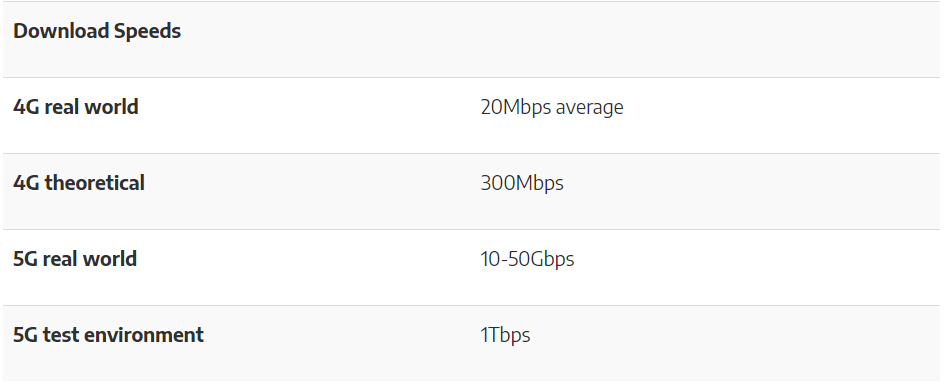
5G will be much, much faster than 4G, making it and even high-speed fibre broadband seem sluggish. A minimum expectation is for download speeds of 10Gbps, more than 1000x faster than 4G and enabling an entire HD film to be downloaded in under 10 seconds. That compares with a similar number of minutes for 4G, which is contingent on having peak rates for the entire download – very rarely the case.
LATENCY
There’s not much point in being able to download an HD movie in under 10 seconds if there’s a lag in being able to watch it. 5G will have far superior latency than 4G enabling play to begin almost, if not, instantaneously. One of the criteria for 5G set out by the GSMA is for latency of 1ms, 50 times better than 4G, although it may be some time before those rates are achievable in the real world.

SPECTRUM/CAPACITY
5G will operate in much higher frequency with larger bandwidths than 4G, to meet the capacity requirements of 5G. However, they can’t travel as far as lower frequency bands and they are not as good as passing through buildings so will be used in combination with lower frequencies to enable wide area 5G coverage.
Spectrum at very high frequencies above 24GHz is commonly known as millimetre wave (mmWave) and has very large bandwidths that will provide ultra-high capacity and very low latency. Cells at mmWave frequencies will have very small coverage so 5G buildout in this spectrum will focus on specific locations requiring very high capacity or areas with high traffic demands.
TECHNOLOGY
5G will build on LTE technology used in current 4G networks but will employ other technologies – some that are already available and others yet to be developed – in order to provide the capacity, speed and ubiquity needed to support the vast range of services and use cases envisaged for 5G. It will use software, cloud-based and other intelligent technologies to deliver a network that is efficient, flexible, scalable, agile and dynamic.
It is likely to comprise lots of small-scale infrastructure deployments (aka small cells) rather than the smaller number of large masts in a 4G network.
Ultimately 5G could be a converged wireless and fixed network infrastructure that provides services to the end device wirelessly, as envisaged in the 5GIC’s Flat Distributed Architecture proposal.
COVERAGE
5G is intended to give the perception of 100% coverage as the quality, speed and predictability of the user experience will give the impression of full coverage, continuous availability and infinite capacity whether the user is at rest or on the move, wherever the user is or going to. Of course, that will not be available nationwide at launch, and likely not for years after commercial services become available.
But, where services are available, coverage will be far superior to 4G.
AND THE WINNER IS…
5G will clearly be superior to 4G in every way – and by a wide margin. However, early 5G services are unlikely to deliver the full potential in terms of speed and latency and full nationwide coverage is years, potentially decades, away. Operators are still investing to improve 4G coverage years after the first services became available, and 5G is going to require a level of investment that could make 4G deployment seem cheap in comparison.

Copyrights©2019 HaiGuang Smart Device All Rights Reserved
ICP 备案号: 粤ICP备15097239号
Contact Details
Contact:
Mr. Markin: +86-18676662525
Miss Kelly: +86-18926582260(whatsapp/wechat)
Mr.Mathew: +86-15986698846
Fax: 0769-81000114
Email:kelly@hgsdcn.com
markin@hgsdcn.com
mathew@hgsdcn.com
Address:
6th Floor,7th.Building, Huixun WanQu Industrial Area, No.4 Baoshi Road, Jiaoyitang, Tangxia Town, Dongguan, Guangdong Province, China
